Short answer: Family-owned restaurants stand out because the people who own them usually make the decisions on site, from the recipes to the service. That keeps the food personal and keeps more money in the local economy. They also tend to show up for nearby schools, teams and neighbors in ways a distant corporate office often cannot.
A family-owned restaurant is an independent eatery owned and run by a family, rather than by a corporate chain or a large franchise group.
Key takeaways
- Most restaurants are small: 9 in 10 U.S. restaurants have fewer than 50 employees, and 7 in 10 are single-unit operations.
- A franchise is not the same thing: a local franchise owner still runs the business inside rules set by the franchisor.
- Money stays closer to home: local independent restaurants return about twice as much per dollar to the local economy as chains.
- Reviews help you find them: reading local reviews is the quickest way to spot a good independent restaurant.
What makes family-owned restaurants different from chains?
The biggest difference is who decides. In family-owned restaurants, the owners set the menu, train the staff and answer for every plate, instead of following a playbook written far away.
Small operators are the norm, not the exception. According to the National Restaurant Association, 9 in 10 restaurants have fewer than 50 employees, and 7 in 10 are single-unit operations (Source: National Restaurant Association). The same research finds that 8 in 10 restaurant owners started their careers in entry-level positions.
Those small teams shape the experience in a few clear ways:
- Personal service: owners are often on site, so feedback reaches the people who can act on it.
- Menus with a point of view: without a corporate test kitchen, a family can add a bold dish because it believes in it.
- Cooking to order: a small kitchen can build its routine around cooking food when it is ordered. See why fresh, made-to-order food beats fast food.
Is a franchise restaurant the same as a family-owned restaurant?
No. A franchise can be owned by a local family, but the franchisor usually decides how it runs, from the menu to the look of the dining room.
The Federal Trade Commission’s guide for franchise buyers explains that franchisors usually control how franchisees conduct business, to keep every outlet uniform. Franchisors may also restrict the goods and services a franchisee sells, and franchisees may owe royalties based on a percentage of gross income (Source: Federal Trade Commission).
That difference shows up on the plate. A franchise owner who wants a new sauce may need approval first; an independent family kitchen can simply try it.
| Question | Independent family-owned | Locally owned franchise | Corporate chain location |
|---|---|---|---|
| Who sets the menu? | The owners | The franchisor, with limited local choice | The head office |
| Can the kitchen add a new dish? | Yes, whenever the owners choose | Usually only with approval | Only through corporate rollout |
| Where does part of each sale go? | Stays with the local business | Royalties go to the franchisor | Profits go to the company |
How do independent restaurants support the local economy?
They keep more of each dollar in town, mostly through local paychecks, instead of sending it to a distant head office.
The American Independent Business Alliance found that locally owned independent restaurants return about twice as much to the local economy per dollar of revenue as chain restaurants (Source: American Independent Business Alliance). Restaurants create an especially large effect because they are labor-intensive, so more of each dollar goes to local payroll.
Across all kinds of businesses, the studies it summarizes found that 48 percent of each purchase at a local independent was recirculated locally, compared with less than 14 percent at chain stores. That money returns as paychecks, purchases from area businesses and donations to area charities. The same paper groups locally owned franchises with absentee-owned businesses.
How do local restaurants build community?
They give neighbors jobs, a place to gather and a partner for school and team events. Owners who work in the community they serve are often quick to say yes.
Restaurants are also one of the biggest employers close to home. In Florida, restaurants and foodservice account for 1,132,100 jobs, and the industry is the third largest private employer in the state (Source: National Restaurant Association, Florida fact sheet). A local restaurant is often where neighbors work, not only where they eat.
Community ties usually look like this:
- Spirit Nights: a school or club brings its families to one restaurant for an evening together.
- School and team catering: local kitchens feed team meals, school events and staff lunches.
In St. Johns, Quig’s Meats & Eats hosts Spirit Nights for schools and groups and is an approved vendor for St. Johns County schools. Details are on the school and team catering page.
How do you find good family-owned restaurants near you?
Start with reviews, then ask neighbors and check the menu.
Reviews are the usual first step: 97% of consumers read reviews for local businesses (Source: BrightLocal). Look past the star rating to comments about the food, the service and who runs the place.
- Read reviews for detail: notes about how the food was cooked tell you more than a score.
- Ask locals: neighbors, coworkers and school parents usually know the independent spots.
- Check for a single location: one address and no national website usually means the owners are close by.
- Read the menu online: house sauces and signature dishes signal a kitchen with its own ideas, as our guide to the best wings near Durbin Park shows.
Where can you find family-owned restaurants in St. Johns?
Start with the independent kitchens on and around County Road 210, then use the steps above to check each one. Quig’s Meats & Eats, a family-owned restaurant, is on County Road 210 in St. Johns.
There is plenty to sort through: Florida has 48,907 restaurant locations, and 9 in 10 restaurants nationwide are small businesses (Source: National Restaurant Association, Florida fact sheet). Chains and franchises sit beside the independents, so ask the franchise question too.
Our list of restaurants on CR 210 covers the corridor, and our guide to lunch near Durbin Park helps on a workday. For a specific craving, see seafood in St. Johns, FL or the best burgers in St. Johns.
How does Quig’s show what a family-owned restaurant can be?
Quig’s Meats & Eats is the kind of independent kitchen this guide describes. The family behind it has fed St. Johns since 2023, and each plate starts when the order comes in, so nothing waits under a heat lamp.
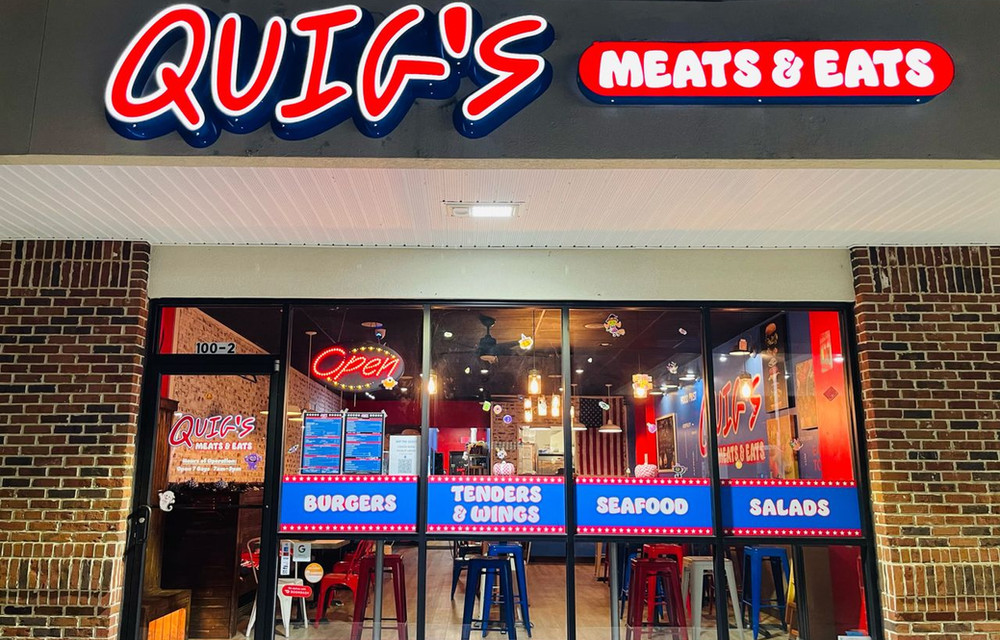
The owner-set menu shows in the details. Burgers use 100% Angus beef, and any one can be made as a lettuce wrap. The Elvis pairs banana, candied jalapeños and peanut butter spread, a dish few chain test kitchens would approve. Wings come with nine sauces, led by the house Q-Sauce. Browse the daily menu, or read our guide to fried chicken in St. Johns.
You can dine in, order online for pickup, or get delivery through a third-party platform. For groups, request a quote on the We Cater page or call. Every catering order needs at least 48 hours’ notice.
Frequently asked questions
Why choose a family-owned restaurant over a chain?
A family-owned restaurant gives you food shaped by the people who run it, not by a distant head office. The owners decide the recipes, train the staff and hear your feedback directly, so changes can happen quickly. Your money also does more locally. The American Independent Business Alliance reports that independent restaurants return about twice as much to the local economy per dollar of revenue as chains, largely through local payroll. Many family kitchens also cook to order and back nearby schools and teams, and choosing them is an easy way to support that.
Are most restaurants in the U.S. small businesses?
Yes. National Restaurant Association figures show that 9 in 10 restaurants have fewer than 50 employees, and 7 in 10 are single-unit operations. That means the typical restaurant is a single location, often run by its owners, rather than one link in a national chain. Many owners also started out in entry-level restaurant jobs, so they know the work firsthand. So when you eat out, there is a good chance you are supporting a small business, and choosing an independent spot on purpose makes that support more certain.
How can you support a family-owned restaurant besides eating there?
Leave an honest review, since BrightLocal found that 97% of consumers read reviews for local businesses, and a detailed note helps neighbors decide. Order pickup directly from the restaurant when you can. Book the restaurant for a team dinner, office lunch or birthday, and give catering requests plenty of lead time. At Quig’s Meats & Eats in St. Johns, every catering order needs at least 48 hours’ notice. You can also bring your school or club to a Spirit Night. Simply telling friends about a favorite local spot helps too.
Family-owned restaurants give a community more than a meal. They keep money local, back schools and teams, and cook with a point of view. To try one in St. Johns, visit Quig’s Meats & Eats at 100 Gateway Circle, Saint Johns, FL 32259, call 904-784-7844, or order online for pickup. The kitchen is open every day from 11am to 9pm, and the Quig’s blog has more local food guides.
Sources
- Federal Trade Commission: A Consumer’s Guide to Buying a Franchise
- National Restaurant Association: National Statistics
- National Restaurant Association: Florida Restaurant Industry Impact (State Fact Sheet)
- American Independent Business Alliance: The Local Multiplier Effect
- BrightLocal: Local Consumer Review Survey 2026
Hungry yet?
Order online for pickup, dine in, or call 904-784-7844. Open 7 days a week, 11am to 9pm.